

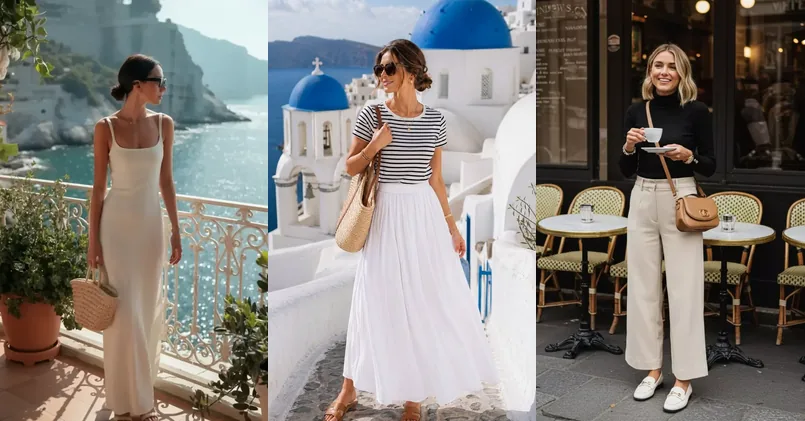
This is my hub post for europe outfits: not a city guide, not a summer packing list, and not a lesson in looking European. I use it when I am planning any trip that touches more than one country and I need a framework before I open a single destination post.
If you want how Europeans dress day to day, read my European fashion styling guide. If you are traveling in June through August and need a capsule for heat and steps, start with Europe summer outfits. For Paris, London, Rome, and the rest, use the city posts linked at the bottom. This page answers: what do I pack first, what do I wear on a ten-mile day in any city, and what mistakes do I see on every first trip?
What I Pack First for Any Europe Trip
Before I choose outfits for Paris or Rome, I settle three trip-wide decisions: one outer layer, one walking shoe, and one neutral base palette. These nine looks are the combinations I test against that checklist.
Camel Coat with Black Tights and Loafers
The camel coat is the one piece I recommend every woman bring to Europe regardless of season. This particular combination works because the coat does the pattern work on its own: warm tan against solid black underneath reads sophisticated without effort. The wrap scarf adds insulation without adding visual clutter. If I were replicating this, I’d look for a coat with a structured shoulder that hits just above the knee. Mango and COS carry reliable versions in the $100 to $180 range that hold up through multiple trips and don’t stretch out after a day of carrying a bag.
Black Leather Coat with Light-Wash Jeans and Chunky Boots
Light-wash jeans against a black leather coat is a combination I see constantly in Berlin and Amsterdam. It works because the light denim stops the all-dark outfit from feeling heavy without introducing a second color. The chunky-soled shoes are not optional if you’re doing serious walking. They absorb impact in a way that flat leather soles don’t, and on a day that involves 10+ miles of old-city cobblestones, that difference is significant. This is a strong cold-weather city outfit for someone who finds all-black too flat.
Layering Up for a Rainy European Afternoon
Rainy European days don’t have to mean a raincoat and misery. This look works because everything underneath the camel coat is already complete on its own: navy sweater, white shirt, gray pleated skirt, black tights, and chunky boots. The coat becomes the weather layer without changing the outfit. I’ve used exactly this layering formula on rainy mornings in London and Paris, and it kept me comfortable from museum to lunch to a walk that turned into two more hours because I wasn’t thinking about being cold.
Black Turtleneck Under a Long Coat with White Sneakers
A black turtleneck under a long black coat with blue jeans and white sneakers is one of those combinations that photographs better than it sounds. The white sneakers are what saves it from looking too severe. On a Paris trip two winters ago, I wore this exact formula for three consecutive days with different jeans, and nobody noticed because the coat signals put-together while the sneakers signal human. It also solves the packing problem: two anchor pieces that pair with nearly everything else you brought.
Trench formulas that work from airport arrival through city walking days without looking like a costume.
Beige Trench Over a Matching Set with a Baseball Cap
This is the casual trench formula: a matching taupe sweater and skirt underneath, Adidas Sambas on the feet, and a baseball cap to signal this is a walking day. The tonal outfit under the trench keeps everything from looking mismatched when the coat comes off. If you haven’t tried Sambas for European travel, they’re worth testing before your trip. The sole handles cobblestones better than most other flat sneakers I’ve worn on long days, and they don’t look out of place in any European city.
Airport-Ready in a Striped Cardigan and Beige Trousers
The airport outfit question comes up every time I talk about Europe packing. My actual answer: wear the thing that serves you best on the first day, not just the flight. This striped cardigan over a white top with high-waisted beige trousers is comfortable for a long flight and looks presentable when you step out wherever you’ve landed. The strappy sandals are a choice I respect in theory but would personally keep in my bag until I was actually at the destination. A large tote bag on top of your suitcase handles in-flight items and frees your hands at security.
Long Beige Trench with a Tan Mini Skirt and White Sneakers
The long trench with a mini skirt is a proportion move that works better in person than in a flat lay. The coat length covers what the mini doesn’t, so you stay warm while the silhouette feels modern rather than bundled. A white button-up underneath keeps it clean. The baseball cap here is part of a pattern I keep noticing across European cities: it signals dressed intentionally but practically. I’d swap the coffee-cup handbag for a small crossbody if you’re doing serious walking, but the look itself is worth copying.
Street looks built for ten-mile sightseeing days, museum AC, and a dinner you did not plan for.
Black Jumpsuit with White Sneakers and a Sweater on Your Shoulders
A jumpsuit is the one-decision outfit for travel: you wear one thing and you’re done. This black version with a neutral sweater draped over the shoulders and white sneakers is the practical version of looking put-together without thinking about it. The sweater on the shoulders is functional here, not decorative. It’s there for air-conditioned museums and cooler evenings. I’d choose a jumpsuit with an elastic waist over a stiff zipper-front for comfort across a full walking day.
Graphic Sweatshirt with Denim Shorts for Off-Duty Days
Not every day in Europe needs to look editorial. Some days you’re at the flea market, the grocery store, the neighborhood walk, and that calls for something like this: graphic sweatshirt, high-waisted denim shorts, white sneakers, and a small shoulder bag. The black cap keeps sun off without requiring SPF reapplication every hour. The contrasting white socks are quietly working here: they visually separate the shoe from the leg in a way that looks intentional rather than forgotten.
Walking-Day Formulas That Work in Any City
These formulas are city-agnostic on purpose. Cobblestones in Prague and hills in Lisbon punish the same bad shoe choices. I group them by how much walking and standing a day involves, not by country.
White Tank Top with Gray Wide-Leg Trousers and a Sweater Layer
Gray and white is an underrated neutral combination for summer in Europe. This tank-and-trousers look is more put-together than it feels to wear, which is exactly what you want when you’ve been walking since 9am and still have a dinner to get to. The gray sweater over the shoulders is temperature insurance. The black sneakers here are a different call than white sneakers in other looks: they ground the bottom half in a way that works better when the trousers are already a lighter shade.
Striped Sweater with Relaxed White Trousers and Loafers
A striped sweater with white trousers is a combination I associate with Spanish coastal towns and French markets. The trick is fit: the sweater needs to be slightly oversized and the trousers genuinely relaxed, not fitted with a wide leg. Loafers finish this better than sneakers because they add visual weight at the bottom in a way that stops the wide trouser from looking too casual. A large tote carries everything you need for a day out without requiring a backpack.
Floral Embroidered Vest with Wide-Leg Jeans
Most Europe packing guides push neutral and quiet. I disagree. A floral embroidered vest over wide-leg jeans is exactly the kind of outfit that photographs well against European architecture, draws no negative attention from locals (who care far more about bad fit than bold prints), and gives you a look that feels personal rather than assembled from a checklist. Keep the bag white and the shoes simple, and the vest does all the work. This is one of the more interesting looks to pull off without looking like you tried.
Elevated city outfits for reservations, rooftop bars, and evening walks when you still have train tickets in your bag.
Sleeveless Taupe Turtleneck with Cream Wide-Leg Pants
Tone-on-tone dressing is something European style does particularly well, and this taupe-to-cream combination is a strong version of it. The sleeveless turtleneck is the piece most people wouldn’t think to pack, but it does real work: it looks intentionally minimal in a way that a regular tank doesn’t, and it pairs with everything. The brown bag is the right call here rather than black, because it stays in the warm color family without matching exactly. Sunglasses at the right scale complete the look without competing with the clothing.
All-Black Blazer Dress with Patterned Tights and Ankle Boots
A blazer dress handles a wide range of situations, from a museum afternoon to a restaurant with a smart casual dress code. The patterned tights here are doing the interesting work: they break up the solid black without introducing a second color. The wide-brimmed hat is bold and I’d only recommend it if you’re actually comfortable wearing hats. It signals from a block away that you dressed on purpose, which is great if that’s your goal and awkward if you’re not used to the attention. Ankle boots with a modest heel add height without the instability of a stiletto on uneven streets.
Red Blazer with White Shirt and Black Mini Skirt
The red blazer is the bold choice most packing guides tell you to leave at home in favor of something neutral. That advice is wrong. A saturated red blazer photographs well against European stone and brick architecture, and it gives you a statement piece that dresses up jeans as well as a skirt. The white shirt underneath and the black mini with sheer tights keep the rest of the outfit grounded. A matching red bag sounds like too much until you see it: the repetition looks deliberate rather than accidental. I wore something close to this in Amsterdam and it turned out to be one of my favorite travel outfits I’ve put together.
White Dress with a Blazer on Your Shoulders
White is underused in European travel packing. People are afraid of it getting dirty, which is a real concern, but a white dress worn on a day when you’re not crawling through ruins or eating street food is perfectly manageable. The blazer over the shoulders adds structure without requiring you to put it on properly, and it covers you in cooler restaurants. Cap-toe flats are a practical heel alternative: they look polished, they’re flat, and the cap toe adds visual interest at the shoe so you don’t need anything else happening below the waist.
Black Leather Trench with a Pop of Color in Your Bag
A black leather trench with a light blue shoulder bag is a combination I notice more in European cities than in the US. Americans tend to match bags to their coat. Europeans use the bag as a color note against an otherwise dark outfit, and the result looks considered rather than coordinated. The light blue reads almost pastel from a distance, softening the black leather without diluting it. If you default to all-black everything, adding one off-color bag to your packing list is the lowest-effort way to make your outfits look more intentional.
Spring and summer Europe picks when heat, church dress codes, and cooler evenings all show up the same day.
Yellow Button-Up Shirt Tucked Into Light-Wash Jeans
Yellow and light denim work well in European summer light. The shirt is tucked, which defines the waist and stops the look from reading as a bag. Black strappy sandals and a black bag anchor both ends of the outfit in the same color. The sandals are the one warm-weather item I’d bring only if I knew I had at least one non-cobblestone day planned: they’re not practical for a 10-mile sightseeing stretch, but they’re ideal for a relaxed afternoon in a neighborhood where you know the ground is forgiving.
Rain, Cold, and Museum AC
European weather lies. A sunny morning can turn into a cold rain hour, and museum AC is its own season. I treat these as layering systems I can repeat in Barcelona or Vienna.
Black Sweater Dress with Polka Dot Tights at Historical Sites
A black sweater dress earns a place in spring packing because European evenings drop faster than you expect, and a dress that covers your arms and knees gets you into churches without a separate cover-up. The polka dot tights add personality without requiring anything else. Chunky boots handle uneven ground at historical sites, and if you’ve done the Roman ruins in flats, you know exactly why that matters. A crossbody keeps your hands free for maps, cameras, and everything else you’re managing while actually looking at things.
Beige Blazer with a White Crop Top and White Trousers
All-white or near-white dressing was something I avoided for Europe until I actually tried it on a Paris spring trip. The beige blazer over a white crop top with white relaxed trousers is lighter and cleaner-looking in person than in flat-lay photos. The sneakers are casual enough to walk in all day, and the small handbag signals you know where you’re going rather than that you’re carrying everything you own. I’d add a thin scarf you can drape over your shoulders for church visits rather than packing something heavier.
Black Oversized Jacket Over a Mini Skirt and Knee-High Boots
This late-spring or early-fall combination solves the in-between temperature problem: too warm for a full coat, too cool for just a layer. An oversized black jacket over a white sweater and mini skirt with black tights and knee-high boots gives you the warmth of two layers while the skirt-and-boots proportion does the aesthetic work. The knee-high boot takes up about the same space as two pairs of ankle boots and works across more combinations. One pair in black earns its weight in a carry-on, especially for trips with unpredictable weather.
These are the destination-specific europe outfits I save when clients ask what changes between Vienna, Italy, Greece, and a Paris spring week—not a new wardrobe, but smarter repeats.
Vienna outfit ideas for museum days and café-lined streets
Vienna rewards quiet polish: structured coats, clean trousers, and shoes that handle stone and tram steps. I pack one dressier layer for opera or dinner and keep the rest walkable.
Carry a crossbody that sits flat on your body in crowded U-Bahn stations. A tote that swings reads tourist faster than any camera.
European vacation outfits when one carry-on has to do everything
Vacation packing fails when every piece works only once. I choose separates that mix across dinner, trains, and ten-mile walking days.
A white linen skirt and neutral top formula shows up in my bag repeatedly because it folds flat and survives heat better than heavy denim.
Chic Europe summer travel looks for city-hopping by train
Train days need outfits that stay presentable after hours in AC and then sudden platform heat. I layer light and keep one scarf for churches.
Summer Europe travel is not one climate. Check each stop’s evening low before you commit to strappy shoes only.
Italy outfit ideas for a multi-city rail trip
Italy changes pace city to city. I pack one polished dinner look, one heat-friendly day look, and walking shoes broken in before I land.
For Rome-specific cobblestones and entry rules, I cross-check my shoe plan against our Rome outfits guide before I finalize the bag.
Europe travel outfits that work in more than one city
Multi-city trips punish over-packing. I repeat neutrals and change accessories so photos still feel fresh in Madrid, Barcelona, and Lisbon.
One structured bag and one walking shoe pair should cover eighty percent of your itinerary if the color story stays tight.
Fall Europe travel layers when the forecast lies
October in Europe taught me to pack for wet wind, not average temperature. Thin merino under a wool coat beats one thick sweater that cannot come off indoors.
I wear the bulkiest layer on the plane and keep the suitcase for flat-fold knits and one reliable boot.
Evening Without a Full Wardrobe Change
I do not pack a separate dinner wardrobe for a two-week trip. These are the tweaks that make a daytime look pass for reservations without a suitcase change.
Spring Europe travel outfits for Rome, Paris, and Amsterdam loops
Spring means variable light and surprise rain. I plan one trench, one mid-weight knit, and trousers that clear puddles without soaking hems.
Rome in spring still needs stable soles. If your week includes Paris cafés and Roman hills, compromise on the shoe that handles both.
Amalfi Coast vacation outfits for ferry days and cliff-side dinners
Coastal Italy is stairs, sun, and wind. I choose dresses that move but do not fly up on ferry decks, and sandals with real grip on wet stone.
Save the highest heel for a dinner you can taxi to. The walk from the pier is where pretty shoes die.
Linen midi dress formula for hot European afternoons
A fit-and-flare linen midi handles heat and still reads dressed for a long lunch. I add a light blazer for AC and church shoulders.
Flats or low block heels beat platforms on uneven old-town streets. Pack blister patches anyway.
What to wear in Rome when sightseeing is the whole itinerary
Rome is a shoe test. I plan outfits around broken-in sneakers or loafers with grip, then build the rest backward from what my feet can handle.
Shoulders covered and knees considered for basilica stops. A thin scarf or light jacket in the day bag saves outfit changes.
Summer 2025 travel wardrobe pieces I still pack for Europe
Trend lists change; carry-on logic does not. I still pack one neutral trouser, one denim, one dress, two tops that swap, and one layer.
If a piece cannot work on a travel day and a dinner, it stays home unless the trip is strictly resort.
Chic Italy outfits for Florence, Milan, and Venice in one week
Italy in one week means train platforms and dress codes. I avoid loud logos and let fit and fabric read expensive instead.
Venice bridges punish wheel bags and wrong shoes equally. Pack for carrying, not rolling.
Spring vacation Europe outfits when days start cold and end warm
Spring packing is layer math. I wear a tee, add a cardigan, add a trench, and remove in reverse as the day warms.
For wider seasonal styling notes, our European fashion roundup covers overlaps worth stealing for travel weeks.
Paris summer outfits for long café days and late sunsets
Paris summer style is quieter than Instagram suggests. I pack breathable fabrics, one red lip, and shoes that survive Seine-side walks.
If Paris is your first stop, build the base wardrobe here then repeat pieces across the rest of the trip with different accessories.
Greece outfit ideas for islands, ferries, and white-stone glare
Greece calls for sun management and wind. I favor flowy silhouettes with secure straps and a hat that will not fly off on a quad ride.
White and blue photograph well but show every ferry splash. A stain pen belongs in the same pouch as sunscreen.
When to Open a City Guide Instead
Once the trip-wide rules are set, city guides do the rest. I link my destination posts here so you do not have to guess which article covers packing versus styling versus one city.
Venice outfits for bridges, vaporettos, and evening spritz tables
Venice rewards compact bags and shoes with flexible soles. Cobblestones plus crowds mean you need to move without thinking about your feet.
Evening looks can stay simple: one silk-touch top, tailored trouser, flat sandal with grip. The city provides the drama.
Paris spring outfit ideas that feel local, not costume
Parisian spring dressing is about proportion: mid-length coat, straight denim or trouser, one good shoe. I avoid head-to-toe athleisure unless gym is the plan.
A light scarf doubles as shoulder cover and wind block on Seine bridges after sunset.
Quiet luxury Parisian winter layers for cold city breaks
Winter city breaks need texture without bulk. I use wool, cashmere blends, and one long coat that closes against wind.
Dark neutrals with one leather bag read polished on short European weekends when you pack light.
Dress and sneakers Europe outfits for ten-mile travel days
A dress with clean sneakers is my cheat code for travel days that end at a nice restaurant. The sneaker keeps the morning honest; the dress keeps dinner easy.
Choose knit or ponte dresses that do not wrinkle in a day bag if you plan to change layers, not whole outfits.
Italian vacation dress code for wedding guests and long lunches
Italian events reward polished simplicity. I pack one midi or tailored dress that works for guest tables and later city walks with a flat swap.
Avoid ultra-casual shorts near churches and fine dining even in summer heat. Light trousers buy you access everywhere.
Capsule travel wardrobe for airport days and week-one repeats
I wear the heaviest pieces on the plane: coat, boots, or structured blazer. The suitcase holds flat items that multiply outfits.
Airport outfits should survive spill risk and still look acceptable at a late check-in dinner. Dark bottoms, washable top, crossbody.
Summer city shorts look when the itinerary mixes heat and walking
Shorts are not wrong in Europe if the city and context fit. I pair tailored denim shorts with a polished top and closed-toe sandal for walking days under ninety degrees.
Save athletic shorts for the hotel gym. City shorts should match your dinner top half so you can extend the day without a full change.
City Guides That Pick Up Where This Hub Stops
For destination-specific days, I keep separate posts so each search intent stays clear: Paris outfits, London outfit ideas, Rome outfits, Barcelona outfits, New York outfits (for comparison packing), and Nashville outfits when I am mixing US and EU trips in one season.
FAQ
What should I pack first for a Europe trip?
One structured coat or trench, one pair of broken-in walking shoes, and two neutral base layers you can repeat. I decide those three before I pick city-specific pieces. That order keeps my bag smaller and my outfits consistent across countries.
How is this different from your Europe summer outfits post?
This hub covers any season and any European itinerary. The summer post is a heat-and-packing capsule for June through August. Use this page for trip-wide rules; use the summer post when temperature is the main constraint.
Do I need different outfits for every European city?
No. I reuse the same walking formulas and change one piece for dress code or weather. City guides help when a destination has a specific vibe or terrain, not because you need a new wardrobe per stop.
What shoes work best for Europe travel?
Broken-in sneakers with a real sole, low block heels I have walked in before, or flat boots in cold months. I never pack new shoes for a trip. Cobblestones expose that mistake by day two.