

This post is about business casual outfits you genuinely want to put on, not ones you tolerate because HR sent a memo. I am not decoding dress codes here and I am not walking hour-by-hour through a workday. Those jobs belong to my business casual outfit ideas field guide and my business casual for work post.
Think of this as the wardrobe mood board: pieces that feel like you inside a business casual lane. If you need rules for denim days, client meetings, or “is this too casual,” open the field guide. If you need morning-to-evening transitions, open the workday post.
Foundation Pieces I Keep Because I Like Them
These are the items I bought because I wanted to wear them again, not because a list told me to. They still pass a typical office code.
Wide-Leg Trousers Are the Investment Most People Delay Too Long
The wide-leg trouser is the first piece I recommend to clients entering a new professional environment. Paired with a tucked white button-down and a brown belt, this combination looks far more polished than its simplicity suggests. What makes it work: proportion. The shirt has to be fully tucked, and the trousers should break cleanly at the ankle. I’ve seen this hold up in law firms and open-plan tech offices alike. A New Day at Target has a wide-leg work version for under $30 that holds its shape through a full day, which is more than I can say for some $80 options.
The Pink Button-Down Nobody Takes Seriously Enough
Most of my clients avoid pink at work without ever thinking about why. A pale pink button-down with white trousers and open-toed heels looks more deliberate than the same outfit in white, because the color signals that a choice was made. I had a client who wore this exact combination for a senior leadership presentation and got three outfit compliments. She’d been wearing gray for two years. Nobody had noticed.
Light Blue Button-Down with Grey Wide-Leg Trousers for Summer Offices
When clients ask what to wear once offices heat up, I point to this combination first: a light blue button-down with volume in the sleeves, tucked into grey wide-leg trousers and finished with a thin brown belt. It reads polished without looking like you dressed for a courtroom. The structured crossbody keeps your hands free for coffee and a laptop, and sleeves pushed to the elbow signal you are practical about temperature, not sloppy about presentation. I keep a blazer in my bag for over-air-conditioned conference rooms, but I do not layer it on by default in July.
Minimalist Dressing Takes More Thought Than It Appears
A beige tank with white wide-leg trousers and a slim belt is harder to pull off than it looks. The color palette is so close that every element has to be exactly right: the fit, the footwear, the bag. Without a structured bag and one pointed-toe heel to anchor it, this slides from clean into underdressed. With those two elements, it’s one of the most versatile combinations in a business casual wardrobe, because the neutral base works across most dress code registers.
Own one good blazer. Not necessarily expensive, but one that fits. The blazer is the closest thing to a universal professional signal in women’s fashion. Put it over almost anything and the outfit looks more purposeful. Every look in this section shows that effect.
A Cropped White Blazer Is Harder to Wear Than It Looks
Contrary to what you see on style boards: the cropped blazer is harder to wear professionally than a regular-length one. The proportion works here because the beige trousers are high-waisted and fitted, which offsets the cropped jacket line. If you try this with wide-leg trousers that aren’t high-rise, the cropped length cuts you off visually and the look falls apart. Get the trouser waist high enough to create one long vertical line and it works well. Get it slightly off and the problem is immediately visible.
Black Blazer, White Top, Beige Trousers: The Formula Worth Memorizing
This is the outfit I recommend first to any client starting a new job who has no idea what business casual means at their specific company. A black blazer, simple white top, and beige tailored trousers will be appropriate in at least 95 percent of office environments. It looks professional without being stiff, and it works with white sneakers when the environment is relaxed. The J.Crew schoolboy blazer in black holds its structure better than most mid-range alternatives and is worth the investment if you’ll wear it weekly.
The Camel Coat That Makes Everything Underneath Look Better
A good coat does more work than most people account for. The camel coat here over a striped blouse, white trousers, and a brown belt creates a strong first impression on arrival that the rest of the outfit has to live up to. Inside the office, the coat comes off and the base look stands on its own. The coat is functioning as a first impression tool. I started recommending this approach specifically to clients who had solid work outfits but hadn’t thought about what their commute looked like to others.
Prints done right signal more confidence than solids, because they require a decision. The key is knowing which prints translate well into professional contexts and why. These four looks use pattern in ways that look purposeful rather than casual.
Combinations That Feel Personal, Not Uniform
Uniform dressing burns out fast. These combinations leave room for color, texture, or one slightly unexpected piece.
The Striped Sweater Rule Nobody Mentions
A striped sweater at work reads differently than you’d expect. The horizontal stripe that stylists always warn against works here because it’s paired with tailored beige trousers and a plaid handbag, both of which balance the visual weight of the stripe. I’ve worn this to client meetings where I needed to look approachable but credible. The sweater keeps the look soft enough to feel conversational, but the trousers and pointed-toe shoes keep it firmly professional. Tuck it in fully. That’s what separates this from casual.
Black and White Stripes Often Look More Formal Than Solid Colors
Here’s something I’ve observed across years of coaching professional women: a black and white stripe often looks more polished than a single solid color. The graphic quality of the pattern communicates a deliberate choice, not a casual one. This blouse paired with wide-leg white pants and classic black heels proves the point. The outfit has visual interest without any single element being loud. Keep accessories minimal. The print is already doing the work.
When a Single Detail Changes How an Outfit Lands
The white bow detail on this black blouse changes how the entire outfit is perceived. Without it, a black blouse and white wide-leg trousers would be clean but flat. The bow signals that someone made a conscious choice. That’s what most people underestimate about professional dressing: it’s not about wearing impressive clothes, it’s about looking like you thought about it. This is one of the lowest-effort, highest-impact combinations in this list.
Why a Silky Texture Justifies a Simpler Silhouette
A silky cream blouse paired with black wide-leg trousers is one of those combinations that photographs well, wears well, and doesn’t require explaining. The fabric texture does the work that a print or detail might do in another outfit: it communicates that the choice was deliberate. Look for polyester-satin blend options if you want the look without the dry-clean requirement. In most offices, it’s indistinguishable from real silk at a distance and holds up better through a full day of meetings.
The button-down shirt is the most underestimated piece in women’s business casual. Not the oversized casual version, but a properly fitted one with structure. These five looks are all built around a button-down, and they cover most situations you’ll face in a standard office week.
Light Blue Photographs Better Than White in Most Office Lighting
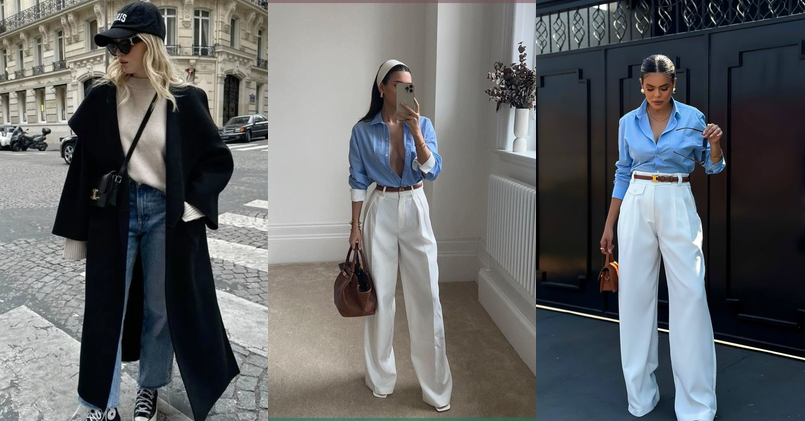
Light blue looks crisp without blowing out under fluorescent office lights or Zoom cameras, which is something I started paying attention to when my clients’ work moved heavily to video calls. This combination, a light blue button-down tucked into white trousers with a brown leather belt, is one I recommend specifically for high-video-call days. The belt creates a defined waistline that registers well on screen. A simple white headband adds personality without looking like a costume.
How One Belt Changes the Entire Silhouette
I want to point specifically to the belt in this look. It’s doing three things at once: defining the waist, adding a contrasting color accent, and visually separating the top from the bottom in a way that creates proportion. Without the belt, this is a shirt and pants. With it, it’s an outfit with a waistline. That’s a meaningful difference, and it costs nothing extra to add.
Wide-Leg Jeans Can Absolutely Work as Business Casual
Here’s where I’ll push back on conventional advice: wide-leg jeans with a tucked light blue button-down can pass as business casual in most modern offices when the denim is a clean wash, not weekend distressed. Most companies, if you pressed HR to define business casual on paper, couldn’t give you a clear answer. What they recognize is whether someone looks put-together. A structured shirt with wide light-wash jeans looks put-together even when the shoes drop out of frame. That’s usually what the policy is measuring. For a broader take on where jeans fit the dress code, the casual Friday work outfits post covers this in detail.
When Business Casual Gets Boring (And What I Change)
When I hit a rut, I change one variable: shoe, belt, or top shape. These looks show the small swaps that reset the week.
When a Dark Trouser Is the More Interesting Choice
A white button-down with dark green tailored trousers is a combination most people would never think to put together, and that’s precisely why it works. The white shirt is so familiar that the dark green trouser looks like a genuine style choice rather than a default. It’s a small deviation from the obvious that signals awareness without any actual risk. For anyone who wants to look interesting without appearing to try, this color pairing is reliable.
The Formula You’ll Come Back to Every Week
If you’ve noticed that light blue button-down and white trousers keeps appearing in this list, that’s not accidental. This combination works reliably because the colors have enough contrast to create visual interest without clashing, the silhouette is clean without being stiff, and it requires almost no decision-making on the morning you wear it. For clients who want to reduce decision fatigue during the work week, having two or three versions of this formula in rotation is one of the most practical recommendations I give.
Not every office asks for the same level of formality. Some workplaces are genuinely relaxed, and sometimes business casual really does just mean “not jeans, or maybe jeans if they’re the right ones.” These five looks live at the comfortable end of the spectrum. See also: going to work outfits for a broader view of what counts across different office cultures.
The Black Coat and Jeans Argument
In a strict reading of business casual, this look, black coat over a cream sweater, blue jeans, and high-top sneakers, probably doesn’t qualify. In most actual offices on most actual Fridays, it does. The coat makes the entire combination look planned. The color palette is controlled enough that the casual elements look like a deliberate choice rather than a default. I’d recommend this specifically for creative fields or tech environments where the business casual label is applied loosely and everyone knows it.
The All-Black Look That Requires More Thought Than It Seems
A black blouse tucked into high-waisted dark trousers looks sharp when the textures work together. The risk with all-black is that it looks flat when everything is the same fabric weight and finish. Here, the blouse drapes differently than the trouser, which creates enough visual distinction to keep the outfit from looking like you grabbed whatever was clean. The pointed-toe heels and brown handbag anchor it. All-black looks need at least one specific accessory choice to cross from “uniform” into “outfit.”
Black Sleeveless Tank and High-Waisted Trousers
I reach for head-to-toe black when I want polish without deciding on three colors before coffee. A structured sleeveless tank tucked into high-waisted trousers keeps the line clean, and a delicate gold necklace keeps the neck from reading too severe on camera. Pointed flats or loafers finish the look below the crop in most mirror shots like this. When the top and pants both fit well, you do not need extra layers to look intentional.
The Layered Look That Solves the Open-Plan Office Temperature Problem
Layering a light blue button-down under a black sweater solves a specific office problem: the air conditioning that runs at 65 degrees regardless of the season. Paired with tailored black pants and white sneakers, it doesn’t look bundled or heavy. The light collar visible above the sweater neckline breaks up the dark tones and makes the layering look thought-through. I’ve worn some version of this combination every fall since I started working in office environments.
The Sweater-Over-Shirt Formula for September Through November
A beige sweater over a crisp white shirt with tailored black pants is one of the most reliable business casual formulas for transitional weather. The collar and cuffs of the shirt visible at the neckline and wrists make the layering look planned rather than accidental. White sneakers bring this to the approachable end of professional, which works in most modern offices. I’d swap in loafers or ankle boots if the meeting is with someone outside the company or significantly senior.
FAQ
What makes a business casual outfit feel worth wearing?
At least one piece I would choose on a day off, fit that does not fight me, and shoes I can stand in through lunch. If I dread putting it on, it fails my test even if it is technically allowed.
How is this different from your other business casual posts?
This post is about liking your wardrobe. The field guide decodes dress codes. The work post covers a full day including after 5 PM.
Can business casual include color?
Yes. I keep color in a top, a bag, or a knit while trousers stay neutral. That keeps me inside code without looking like a catalog.