

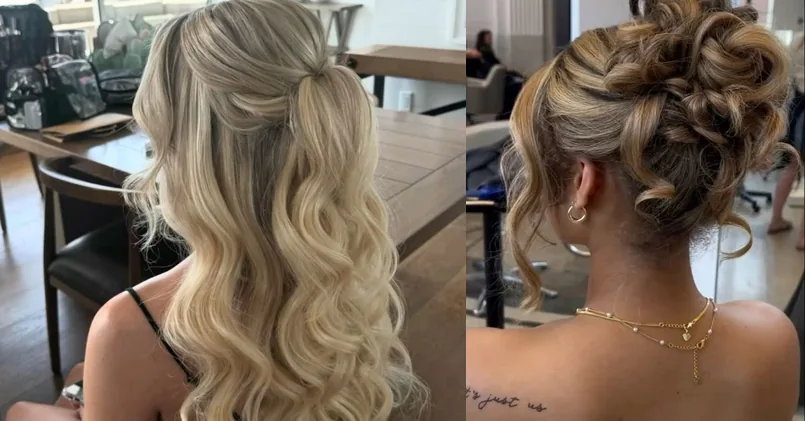
Homecoming is one of those nights where the hair question feels more loaded than it should. I’ve watched clients sit across from me in Boston, weighing a blowout against an updo, talking themselves out of the style they actually wanted because they weren’t sure it was “appropriate.” Here is what I tell them every time: appropriate is not the goal. Looking like yourself at your absolute best is the goal, and those are not the same thing.
I’ve been collecting these homecoming hair references for clients who come to me at a styling crossroads. What works isn’t always what trends on Pinterest. What works is the style that still looks like you at midnight, after the dancing and the photos and the drive home.
Classic Updos That Command Attention
Classic updos that command attention without reading like a ballet recital—face-framing pieces, intentional texture, and necklines worth showing off.
Curly Updo with Face-Framing Tendrils
The volume here comes from curls pinned at the crown rather than pulled back flat. That distinction matters. A flat, tight updo reads formal in the wrong way, like a ballet recital rather than a dance. The loose tendrils are doing real structural work: they soften the silhouette so the style reads elegant rather than severe. I’d skip a heavy statement necklace with this one. The hair is already making a strong visual case on its own.
Textured Bun with Soft Face-Framing Pieces
This is what a genuinely good textured bun looks like: not messy, not overly polished. The face-framing pieces are critical. Pull everything back too tightly and you lose the softness that makes this style work for an occasion rather than a gym session. I’ve seen clients try this with too much product and end up with something that looks crunchy instead of intentional. Use a light-hold mousse before curling and nothing else after.
Glamorous Updo with Curls and Braided Detail
Combining loose curls and delicate braids in a single updo is more intentional than it looks. The braids provide the framework that keeps the curls from collapsing by the end of the night. For anyone whose hair doesn’t hold curl reliably, this structure is actually the more practical choice: the braid architecture carries the look even as the curls loosen.
Loose Braided Bun with Statement Earrings
The face-framing strands are what separate a braided bun that looks sculpted from one that looks like it belongs on an actual person at an actual event. For this specific style, a light application of Ouai Hair Oil pressed over the finished bun keeps the texture defined without the stiffness that most hairsprays introduce. A pair of longer earrings works particularly well here since the neck and collarbone are fully exposed.
Confirmation and ball updo energy for a formal homecoming line
European confirmation and ball updos share DNA with homecoming hair: face-framing pieces, a defined crown, and nothing so tight it reads like a recital. I pin styles like this when clients want polish without losing softness.
If your dress has an open back, leave tendrils intentional. Pull everything flat and you lose the warmth that makes the look feel like you at midnight.
Long bridal-style updo volume for strapless homecoming dresses
Long hair pinned high reads homecoming-ready when the neck stays clear and the texture looks touchable, not shellacked. I suggest this silhouette for strapless or one-shoulder dresses where the hair carries the frame.
Practice pin placement twice before the night. One loose section at the nape is easier to fix at the venue than rebuilding the whole updo.
Festive updo with soft framing for photo-heavy evenings
Soft face-framing layers keep an updo from looking severe under flash. I set curls before pinning so the pieces fall naturally instead of springing out mid-dance.
This is the shape I recommend when someone says they want an updo but fear looking too done up. The looseness is structural, not accidental.
Simple bun with curly edges for textured hair at formal events
Curly edges at the hairline make a bun feel personal instead of generic. I smooth the crown, then let texture live at the temples so the style still reads like your hair.
For strapless dresses, this bun line exposes the collarbone cleanly. Skip a heavy necklace and let the earring do the work.
Guest-table updo polish when you want homecoming hair without prom volume
Not every formal night is your own dance, but guest-table hair still needs intention. A low bun or soft updo with face framing reads polished in group photos without stealing focus.
I keep product light at the roots so the style survives warm rooms. A flexible-hold spray beats a stiff lacquer for hours of conversation.
Romantic Curls and Cascading Waves
Romantic curls and cascading waves for homecoming nights when you want length in photos and structure that survives dancing.
Cascading Curls with a Bow Detail
The bow is the element that makes this distinctly homecoming rather than generic formal. It signals deliberate styling without going overboard. The curls need consistent sizing for this to look intentional, not improvised. I’d recommend a one-inch barrel curling iron, not smaller. Tight ringlets and a bow do not work together the way loose spirals do.
Flowing Waves with Blonde Balayage
Balayage and soft waves complement each other in a way that single-tone color simply does not replicate. The dimension in the color creates natural contrast within the waves. If your hair is darker, the waves still read beautifully, but using a diffuser at the roots adds volume that lightened hair gets naturally from the reduced weight at the ends.
Romantic Cascading Curls with Twisted Back
The twist at the back is subtle but structural. It keeps this from being simply “hair down with curls” and gives it a sense of purpose. This is a solid choice for anyone with thick hair: the twist manages the weight at the back so you are not fighting your own hair for the second half of the night.
Braid Crown with Long Loose Curls
This is the style I recommend most often to clients who feel uncomfortable in a full updo but still want something that reads formal. The braid crown gives you the polish of an updo while leaving the curls free. It is also more practical than it looks: the crown anchors everything, so even if a few curls fall during the night, the overall structure stays intact.
Half-Up Curls with Blonde Highlights
The highlights create dimension that changes how curls read under event lighting. A small half-up section at the crown keeps the front of the style looking intentional without committing to a full updo. The focal point stays on the curls, which is the right call when the texture is this defined.
Glossy Curls with Twisted Crown Section
The glossy finish here tells me there is a good serum in the routine. Olaplex No. 6 Bond Smoother applied to damp hair before styling controls frizz without weighing curls down, which is exactly what you need when the event runs into the night and humidity is a factor. The twisted crown section at the top is doing double duty: it reads as formal and it keeps the front of the hair in place.
Cascading Curls with Pearl Hair Pins
Pearl pins work best in curls when they are scattered rather than clustered in one spot. The detail most people miss: place them while the curls are still slightly warm from the iron, so the pins nestle into the spiral rather than sitting on the surface. Once the hair cools, they stay put for the rest of the night without additional securing.
Brown homecoming curls with prom-level shine
Rich brown tones photograph beautifully when curls are sized consistently and the part stays clean. I use a one-inch barrel and alternate curl direction so the waves do not clump into one sheet.
Homecoming hair should still look like movement, not helmet hair. A light serum on the lengths only keeps shine without flattening the root.
Dark long hair homecoming ideas when you want drama without an updo
Dark hair carries curl and wave with less visual noise than lighter tones, which is an advantage in dim gym lighting. I build volume at the crown with a half-up pin or twist so the length still shows.
If humidity is in the forecast, I set with mousse on damp hair and finish with a flexible spray, not a heavy oil at the scalp.
Simple long-hair homecoming shape when you have twenty minutes
Simple does not mean skipped. A clean part, soft bend through the lengths, and one pin at the crown often outlasts an overcomplicated updo on a busy Saturday.
I tell clients to match effort to the dress: if the gown is loud, keep hair calm. If the dress is minimal, let one curl or bow detail carry the story.
Cute prom curl inspo that translates to homecoming photos
Prom and homecoming share the same photo pressure: you need a style that survives dancing and still reads in flash. Soft romantic curls with a secured crown section do both.
Practice the curl pattern once on a weekday. Muscle memory matters when you are styling under time pressure.
Prom-wave homecoming hair for warm-climate kickoff nights
Loose waves work for homecoming when the front is controlled and the back has intentional movement. I clip the crown while the lengths cool so the shape sets before you leave the house.
Wind on the walk in can undo a perfect blowout. A half-up anchor at the top buys you hours before you need a bathroom touch-up.
Summer formal curl ideas when homecoming lands early in the season
Early-season homecoming often means heat and humidity together. I prep with anti-frizz on damp hair, diffuse if needed, and avoid heavy oils that attract moisture from the air.
Roundup pins like this are a menu, not a mandate. Pick one element—crown twist, ribbon, or curl size—and build the rest from what your hair actually does.
Half-Up Styles That Work for Every Hair Type
Half-up styles that work across hair types—the sweet spot between full updo and hair-down chaos.
Low Ponytail with Cascading Waves
A low ponytail with volume is harder to pull off than it looks, and that is exactly why it reads as intentional when done well. The wrapped section at the base covers the elastic and creates a finished look without visible hardware. I’ve suggested this style to several clients over the years who wanted something polished but were not comfortable committing to an updo. It delivers the same sense of effort with much less risk.
Half-Up Braided Crown with Flowing Waves
This style works across hair types and textures, which makes it one of the more reliable choices in this list. The braided crown section works with both straight and wavy hair. What most tutorials skip: the crown braid reads better when it is slightly loose rather than pulled tight against the scalp. A too-tight braid creates surface tension that shows in photos and causes discomfort after a few hours.
Twisted Half-Up with Cascading Waves
The twist at the crown is what moves this from a casual half-up to something that reads as a considered styling choice. It also holds better than curls alone: the twist section is secured, so even if the bottom waves soften throughout the night, the top still looks put together. Pair this with a strappy back neckline and the twist creates a strong visual line from shoulder to crown.
Half-Up with Intertwined Side Braids
Two side braids meeting at the back require practice to get right, but once the technique is there, the style holds all evening without clips or extra product. For anyone with fine hair, this is worth the extra effort. The braids add texture and visual weight that fine hair often lacks in looser styles. If you want more ideas in this direction, these sleek braided ponytail styles cover similar braid-forward techniques.
Half-Up Ponytail with Voluminous Blonde Waves
The volume on the ponytail section is what separates this from a standard half-up. The hair at the crown is lifted before being secured, creating a rounded silhouette at the top that reads as styled rather than quick. Pair this with a strapless neckline. The height of the ponytail works particularly well when there is no collar or strap competing for visual attention at the shoulder line.
Effortless Half-Up Twist with Dimensional Blonde
This style reads as intentionally undone in a way that takes actual skill to get right. The dimensional blonde means every wave has visible contrast even under venue lighting that can flatten finer details. This is the style I’d point to when someone tells me they don’t want to look “too done up” but still want something that photographs well. There is a difference between undone and unfinished, and the half-up twist is what communicates which side of that line you are on.
Sweet sixteen half-up energy for younger formal nights
Half-up styles solve the face-framing problem without hiding length. I secure at the crown first, then curl what hangs so the top stays neat through group photos.
This reads younger without looking childish when the part is clean and accessories stay minimal.
Half-up half-down twist with floral detail for picture-heavy nights
A twist at the crown with soft flowers reads formal because the structure is deliberate. I weave pins while the curl is still warm so details nest instead of sliding.
If your school restricts large accessories, swap flowers for small pearl pins scattered through one side.
Graduation-medium hair half-up when length sits between updo and full down
Shoulder-to-medium length needs a half-up anchor or the style collapses by hour two. I lift at the crown, pin, then wave the tail so the silhouette stays round from the side.
Medium hair is underrated for homecoming: you get updo polish with less pin work than long lengths require.
Half-up half-down prom shape you can reuse for homecoming 2026
This silhouette is the compromise I suggest most often: show length, keep eyes clear, survive dancing. I tease lightly at the crown only, then smooth the sides for a clean panel.
A second elastic hidden under a wrap section keeps the half-up from sliding when the floor gets crowded.
Formal hairstyles for younger grades when homecoming feels like a first big night
Younger formal nights still deserve intentional hair, not a rushed ponytail. Clean parts, controlled edges, and one secured section at the crown read polished without age-inappropriate volume.
I keep styles low-tension for long nights. A headache at nine ruins photos more than a slightly softer curl ever will.
Medium-length homecoming updo ideas when a full bun feels like too much
Medium hair can live in a low twist or partial updo that clears the neckline without a towering bun. I pin in an X pattern at the nape so the shape stays flat in chair photos.
Test with your dress straps on. Hair and neckline should share the frame, not fight for space.
Sleek and Statement-Making Options
Sleek and statement-making options when soft romantic is not the whole story.
Sleek Ponytail with Side Braids and Curled Ends
The braids at the sides are what keep this from being a basic ponytail. They add a geometric structure that reads as formal rather than just practical. The curls at the end of the ponytail balance the sleekness at the top: without them, the style would read as severe. If your natural hair is straight, a flat iron on the top section followed by a curling iron on the ponytail achieves the same contrast. For more sleek ponytail variations, these sleek ponytail hairstyles are worth saving.
High Ponytail with Swooped Baby Hairs
The baby hairs at the front are the finishing detail that make this style look complete rather than hurried. They are swooped and set, not flat, which keeps the look polished without looking heavy-handed. A high ponytail without intentional hairline detail can look unfinished at close range even when the rest of the style is strong. The got2b Ultra Glued Gel applied lightly to a dry edge with a soft brush creates the definition here without the gel-heavy look that most edge products produce.
Braided Half-Up with Ribbon Accents
The blue ribbons work here because they are woven into the braid rather than tied on top. That distinction is what separates this from costume territory. My honest take on accessories like this: they read better in person than in photos, so if the night itself matters more to you than the album, this is worth trying. If your homecoming photos are the priority, stick with a more neutral accessory.
Loose Cascading Curls with Half-Up Sweep
Most homecoming style guides will tell you that full-down curls are automatically the most glamorous option. I would argue the opposite: curls worn completely down with no structure at the crown can look like you skipped the styling decision entirely. The half-up sweep here is what communicates that the curls are intentional. It creates a clear starting point at the top that anchors the entire look. For additional everyday hairstyle ideas that translate beyond formal occasions, the school hairstyles guide and this sleek bun collection are both worth saving for reference.
Thirty hoco hairstyles for every hair type on one reference board
Every hair type label on Pinterest still comes down to the same checks: tension, hold, and whether the style survives humidity. Pick the category that matches your texture, then ignore the rest.
Fine hair often wins with braids or twists for grip. Thick hair often wins with partial updos that manage weight at the back.
Twenty-eight homecoming looks for long curly hair and wedding-guest crossover nights
Long curly homecoming hair works when moisture and structure share the plan. I set curls, pin at the crown if needed, and refresh with a light leave-in instead of re-ironing mid-night.
Guest-table lighting is harsher than gym fluorescents. A quick phone check in daylight before you leave catches frizz you will not see in the bathroom mirror.
FAQ
What is the best homecoming hair style for long hair?
For long hair, the best homecoming styles are those that work with your length rather than hiding it. Loose cascading curls, a half-up style with waves, or a voluminous updo with curls cascading at the back all photograph beautifully. The key is picking a style that your hair can hold for four-plus hours without constant maintenance.
How do I make my homecoming hairstyle last all night?
Prep is the biggest factor. Start with clean hair that has been washed the day before, not the morning of, since day-old hair holds curl better. Apply a light-hold mousse before heat styling, and finish with a flexible-hold spray rather than a stiff lacquer. For updos, pin strategically rather than piling on product.
Should I do my homecoming hair myself or go to a salon?
If you have a specific style in mind that requires precise sectioning or intricate braiding, a salon visit is worth the cost. For styles like soft waves, a basic half-up, or a simple low ponytail, practicing at home twice before the event is usually enough. The real question is whether you can reliably replicate the style yourself under time pressure.
How far in advance should I prepare for homecoming hair?
Practice your chosen style at least twice before the event, ideally two weeks out and then again three days before. This gives you time to adjust the technique, buy any missing products, and troubleshoot hold issues. On the day itself, give yourself at least 90 minutes for the actual styling so you are not rushing.
What hair accessories work best for homecoming?
The accessories that hold up best throughout the night are those that are actually secured into the hair rather than resting on top. Bobby pins, small claw clips placed inside a style, and braided-in ribbons stay put. Headbands and hair combs that sit on the surface tend to slip. If you want a visible accessory, pearl pins or small decorative clips woven into the style are the most reliable option.