

London is one of those cities where I can leave a hotel at 8 AM in bright light, get mist by noon, and end the day in a windy dinner queue near the river. I coach women through job transitions and high-pressure moments, and travel styling comes up in almost every conversation. A great london outfit is not about looking dramatic for one photo. It is about staying comfortable, polished, and ready for a full day of movement without feeling overdressed.
I built this guide from real trips, coaching sessions, and honest trial and error. You will not see fantasy packing lists here. You will see practical formulas, why each one works, and where I would adjust based on weather, schedule, and budget. If you have ever packed for London and still felt like nothing worked together, this is the system I use to fix that problem quickly.
London Outfit Formulas That Work in Real Weather
1) Long coat plus knit plus straight-leg jeans
This is my most repeated travel formula because it is stable, flattering, and easy to adapt. I start with straight-leg denim, then add a fitted knit and a coat that hits mid-calf or slightly below the knee. The longer coat creates a cleaner vertical line and blocks wind better than cropped outerwear. On one October trip, I switched between ankle boots and clean sneakers with this same base and never felt underdressed in central London.
If you run cold, choose a merino knit instead of cotton. If you run warm, keep the knit lighter and rely on the coat for insulation. Most people overpack statement tops, but this base does more work than five random pieces.
2) Blazer, tee, mini or midi, and weather-proof boots
London streets reward structure. A blazer gives that instantly, while a simple tee keeps the look approachable. If you like skirts, pick one with movement and pair it with boots that have real grip. I care more about traction than trend when I style clients for rainy cities. Slick soles might look sleek for ten minutes, then become stressful on wet paving stones.
For a practical variation, swap the mini for a midi and add sheer or thermal tights depending on the season. This formula also connects well with my rainy day outfit for work advice if your trip includes meetings.
3) Leather layer with soft knit contrast
Leather outerwear gives instant shape, but the outfit feels better when you balance it with a softer knit or brushed cotton underneath. I often see women go too hard with all-sharp elements and then wonder why the look feels stiff. A london outfit should move with you through transit, museums, and long coffee lines. Contrast in texture helps that happen without losing edge.
My preferred budget split here is simple: spend more on the jacket, save on the base knit, and keep accessories minimal. A reliable faux leather or real leather coat in black or deep brown can carry multiple city trips across seasons.
Packing Strategy That Prevents Last-Minute Outfit Panic
4) Build a three-color capsule
I plan London packing around three colors: one dark neutral, one light neutral, and one accent. Example: black, cream, and cobalt. This keeps every piece compatible while still giving personality. When clients ignore this and pack six unrelated colors, they get more items but fewer usable outfits. The capsule method looks strict, yet it creates freedom once you are actually dressing in a small hotel room.
A practical accent can be a scarf, beanie, bag, or knit. You do not need multiple bright pieces. One is enough to keep photos and daily looks from feeling repetitive.
5) Use one shoe category per day type
I separate shoes by day type: heavy walking days get supportive sneakers or low boots, event evenings get a cleaner heeled boot or refined flat, and mixed days get the bridge shoe that can do both. This sounds obvious, but it saves space and decision fatigue. On my last multi-stop trip, I packed three shoes total and repeated each one strategically. My feet survived, and every outfit still looked intentional.
If you are between two options, choose comfort first and sharpen the outfit with structure on top. Pain changes posture, and posture changes how every outfit reads.
6) Keep one dedicated rain layer ready
Even when the forecast looks friendly, I keep one reliable rain layer in rotation. That can be a treated trench, a compact umbrella, or a packable shell that sits under a coat. I do not wait for rain to decide this. I plan it before the trip. The women I coach who travel most often always do this, and they look calmer on weather-shift days because they are not scrambling for last-minute fixes.
My one controversial opinion: a stylish rain layer is more valuable than a fifth sweater. Most wardrobes have enough knits. They do not have enough weather solutions.
How I Style by Schedule, Not by Aesthetic Mood
7) Sightseeing day: comfort-led polish
For museum hopping, neighborhood walks, and public transport, I choose a stable base with one polished layer. Think denim or trousers, knit or tee, then a structured coat or blazer. The goal is zero friction while moving. I styled this formula for a client who wanted city photos but had knee discomfort. We kept the outfit clean, reduced heel height, and she still looked sharp in every shot.
When you need more ideas for city-specific packing logic, my new york outfits guide follows the same movement-first approach with different weather assumptions.
8) Travel day: soft waistband, sharp top line
Airport and train days are where most wardrobes collapse into either sloppy or uncomfortable. I prefer a soft-waist bottom, supportive shoe, and crisp top layer. That could be a smooth knit with a blazer, or a fitted tee with a long cardigan and coat. You stay comfortable in transit but still arrive looking ready to walk straight into your plans.
This is also where a crossbody bag helps most. You can move quickly, keep essentials close, and avoid shoulder strain from heavy totes.
Real Product Picks I Recommend for a London Outfit Capsule
9) Merino knit over synthetic-heavy blends
If your budget allows one knit upgrade, make it merino wool in a medium gauge. It regulates temperature better, layers cleanly under coats, and usually resists odor longer during travel. I have repeated one merino crew neck for three active days with quick overnight airing, and it still felt fresh. That is hard to replicate with lower-quality synthetics that trap heat and lose shape quickly.
A good price band is often around $80 to $160 depending on brand and sale timing. That range gives visible quality without luxury-level spend.
10) Water-resistant ankle boots with supportive insoles
My second non-negotiable is a water-resistant ankle boot with grip and cushioning. Style matters, but function protects your energy for the whole day. I suggest a block heel under two inches or a flat sole with real support. Cheap boots that look good online often fail after four hours of walking, and then every outfit decision feels harder because your feet are exhausted.
A reasonable spend range is $120 to $220 for a pair you can repeat for several seasons. That is often cheaper than replacing weak pairs every year.
11) Medium structured crossbody over oversized totes
Most travelers carry too much. I prefer a medium structured crossbody with enough room for essentials, a compact umbrella, and one small pouch. Oversized totes can look stylish in still photos, but they pull your shoulder line down after a few hours and make polished outfits look tired. A structured bag keeps shape and helps the outfit read intentional from morning to evening.
For style reference in warmer city wardrobes, you can compare this bag logic with barcelona outfits and see how the same structure works with lighter fabrics.
Mistakes I See Repeated in London Packing
12) Packing too many trend pieces and no core layers
Trend pieces can be fun, but they are not a system. I regularly meet women who pack four statement items and then realize nothing works together. A strong london outfit plan starts with repeatable base layers first, then adds selective personality. If your suitcase opens and everything demands attention, you will spend too much time deciding and still feel unsure when leaving the hotel.
My fix is simple: choose three core bottoms, three core tops, two outer layers, and one accent group. You can build many combinations from that without chaos.
13) Ignoring hem length and movement tests
Before any trip, I do a quick movement test at home: stairs, seated position, and brisk walking. If trousers drag, skirts ride, or coat sleeves feel restrictive, I fix that before packing. People underestimate how much this matters. London is a movement city, and clothing that works only in mirror selfies creates stress by midday.
This ten-minute test has saved me from multiple poor choices, especially with wide-leg pants and new boots that felt fine in short wear but failed in real walking conditions.
14) Treating every day as a photo shoot
I love a great photo, but I do not style entire travel days around one image. When every look is optimized only for pictures, comfort and practicality disappear. Then your energy drops, and the photos suffer anyway because you look uncomfortable. I would rather build outfits that feel good for six to ten hours and still photograph well at natural moments.
That balance is what gives repeat confidence. It is also why my approach overlaps with the practical city planning in paris outfits rather than trend-only content.
A Simple Four-Day London Outfit Plan
Day 1: Arrival and neighborhood walk
Wear your heaviest outer layer on travel day, pair it with soft trousers or jeans, and keep shoes fully broken in. Add one polished accessory so you can go from transit straight into a casual dinner without changing everything.
Day 2: Full sightseeing schedule
Choose your most supportive shoes, a breathable knit, and weather-ready coat. Keep your bag light and your layers easy to remove. This is usually your highest-step day, so function should lead.
Day 3: Mixed agenda with evening plans
Start with a neutral base and swap only two things before dinner: your outer layer and one accessory. This gives a visible shift without carrying extra complexity all day.
Day 4: Flexible repeat formula
Use the pieces that performed best earlier in the trip. Repeating a successful formula is a strength, not a failure. Good styling is often repetition done intentionally.
London Landmark Outfits That Still Photograph Well After Hour Three
Denim midi skirt and a crossbody for the Big Ben walk
I give this formula to clients who want one solid landmark photo without spending the morning deciding what to wear. A denim midi skirt with a plain white top and a crossbody bag has enough movement to look natural mid-stride instead of posed, and the proportions work on nearly every body type.
White sneakers keep the outfit wearable for whatever comes after the photo, which matters more than people expect. I have seen good outfits fall apart because someone chose the shoes that look right for ten minutes instead of the ones that survive Westminster to lunch.
Pink pleated midi and a wrap top by the red phone boxes
The red phone boxes are one of the few backdrops in London that reward color instead of competing with it. A soft pink pleated midi skirt against that red is one of my favorite pairings in this whole guide, and a simple black wrap top keeps the top half quiet so the skirt carries the color.
I would swap the flats for a low block heel if the day includes limited walking. Otherwise stay in flats. No landmark photo is worth a blister an hour into the trip.
Denim vest and knee socks for a playful afternoon by the Eye
This is the one outfit in the new batch I would not build a full day around, and I say that as a compliment. A denim vest over a white top and mini skirt, finished with knee-high socks and boots, reads younger and more playful, which makes it perfect for a short outing near the Eye rather than a marathon sightseeing day.
Save it for the afternoon between two more practical outfits. The mini skirt limits how much walking feels comfortable, and that is fine when you plan around it instead of against it.
Camel beret and coat over a black turtleneck dress
One client told me she felt self-conscious the first time she wore a beret in real life, and then stopped noticing it within twenty minutes because everyone around her looked just as intentional. A camel coat and matching beret over a simple black turtleneck dress is the most classic look in this new group, and the color story carries the whole thing.
Keep the same weather-proof boots you packed for everything else underneath. You do not need special shoes to make a look like this work.
Suede jacket for a slow walk past the double-deckers
I pack one soft suede or corduroy jacket on every trip because it works over almost anything underneath, a dress, jeans, or a simple skirt, and it never reads as trying too hard for an ordinary afternoon. The warm brown tone photographs well against London’s brick and stone without much effort.
This is the outfit for a day with no real agenda beyond walking and looking around. Some of the best travel photos come from days like that, not the planned ones.
Refined London Day Looks for Museums, Shopping, and Slow Mornings
Cream cropped jacket over a full white midi skirt
White can feel risky for a full day out, so I tell clients who want to try it to carry a small stain pen and choose flats over anything open-toed. A cream cropped jacket with a full white midi skirt is one of the most polished combinations in this guide, and the volume in the skirt keeps it from feeling stiff against London’s red-brick streets.
This works especially well outside townhouses and hotels with the kind of architecture London does so well. It is worth the extra care the color demands.
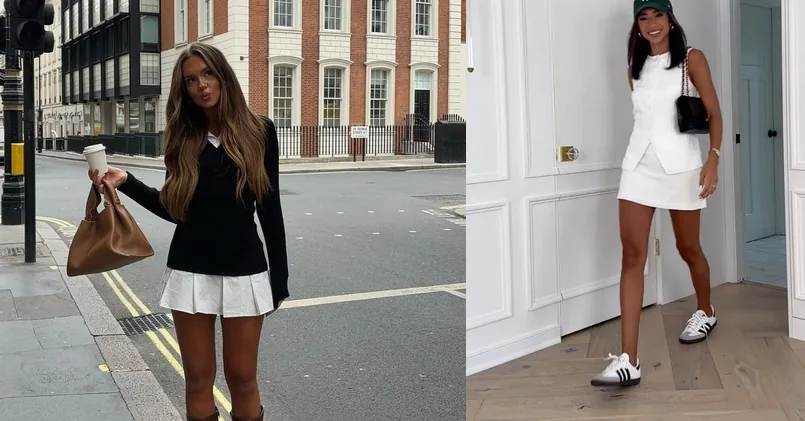
Black sweater, white pleated mini, and knee-high boots
I come back to this formula for clients who want to look put together without matching anything too carefully. Black on top and white on the bottom with brown knee-high boots does most of the visual work on its own, and the pleats move easily when you sit down.
This is a strong choice for a day that moves between a museum, lunch, and a bit of shopping, since the boots keep your legs warm without asking you to sacrifice the shorter length.
The camel trench that carries the whole outfit
A well-cut camel trench over a simple black base is close to a uniform for me when I travel to cities with unpredictable weather, and London qualifies every time. The coat does the work so I do not have to think hard about what is underneath.
I would rather spend more on one trench I repeat for a decade than on five trendier coats I retire after one season. This is the piece worth the higher end of your budget.
Olive bomber jacket over a white turtleneck
Shoulder-season trips are hard to dress for because the morning is cold and the afternoon warms up fast, and this is the formula I reach for when that happens. An olive satin bomber over a white turtleneck and dark jeans lets you tie the jacket around your bag once the temperature shifts.
The sheen on the bomber keeps this from looking too casual, which is why it belongs with the more refined looks here instead of the everyday group below.
Everyday London Outfit Formulas for Off-Duty Days
Oversized graphic tee with baggy wide-leg jeans
I do not think every day of a trip needs to be styled. Some days are for recovering from the other days, and an oversized graphic tee with baggy wide-leg jeans and white sneakers respects that without looking sloppy.
This is the outfit I recommend for a rest day, errands, or the flight home. Nothing about it requires effort, and the loose fit stays comfortable for hours at a time.
Olive sweater, wide-leg jeans, and loafers
I recommend this kind of muted, tucked-in formula to clients who tell me they feel most like themselves in quiet colors. A soft olive sweater tucked into wide-leg jeans, finished with loafers and a simple belt, works from a Tuesday morning at home to a Tuesday morning in London.
There is no reason a travel outfit has to look different from how you already dress. This one looks intentional without reading like it was planned for a photo.
Black leather jacket over a simple tank and light denim
A cropped black leather jacket is one of the fastest ways to make a basic tank and jeans look intentional, and it gives an outfit an edge without much effort. Light wide-leg jeans keep the whole silhouette from feeling too heavy.
I would keep the jewelry minimal here and let the jacket be the statement. Add too many strong elements at once and the look stops feeling relaxed.
White tee under a black maxi pinafore dress
This is a good formula for a day with a lot of standing, museum queues, or a market, since the length moves with you and nothing needs adjusting after you sit down. Layering a plain white tee under a long black pinafore-style dress and finishing with sneakers gets you a maxi silhouette without sacrificing comfort.
The sneakers keep it from feeling like an evening look. Swap them for boots in colder weather and the same dress carries into a different season.
White matching set with sneakers and a baseball cap
I like white sets like this for warmer trips specifically because they look sharp against almost any London backdrop, brick, stone, or greenery. A matching white top and mini skirt with a baseball cap and black-and-white sneakers reads sporty rather than dressy, which suits a day with more walking than sightseeing formality requires.
A small structured bag keeps the look from tipping too casual. This is a good option when you want to feel put together without dressing up.
Warm-Weather London Outfit Ideas for the Rare Sunny Days
Pale yellow mini dress under a white blazer
I save this formula for warmer trips or late spring, when a London morning still starts cooler than the afternoon and a blazer solves that problem without extra layers to carry. A pale yellow tiered mini dress under a white blazer gives you color without losing structure.
A neutral tote and simple sandals keep the rest of the look quiet so the color of the dress stays the focus.
Blue button-down shirt with tailored white shorts
I would only recommend shorts like this on a day with limited walking, since the heel and the shorter length are not built for hours on cobblestones. A soft blue button-down tucked into tailored white shorts, finished with heeled sandals, is one of the more tailored warm-weather formulas here and works well for lunch or a gallery.
Keep a light cardigan in your bag for museums that run cold with air conditioning. It is an easy fix that saves the whole outfit.
White tank top with a green floral midi skirt
This is a good one to repeat with a different top later in the trip since the skirt is the memorable piece, and nobody notices repeated basics underneath it. A plain white tank with a green floral midi skirt and white sneakers works for a slower day, a bookshop, or a coffee stop between bigger plans.
The floral print does the personality work while the rest of the outfit stays simple enough to build around.
White tee with a gingham maxi skirt
I recommend pairings like this to clients who want to feel put together on days when they genuinely have low energy for getting dressed. A plain white tee with a brown gingham maxi skirt and ankle boots is soft and relaxed, and the print gives it personality without asking for extra effort.
Comfort and personality do not have to be opposites. This is proof of that on a day with no real plan beyond wandering.
White tee with a mustard maxi skirt and a straw bag
If you only pack one colorful skirt for a London trip, I would make it mustard or yellow over anything brighter. It reads as intentional rather than loud in most city settings, and a mustard tiered maxi skirt with a plain white tee closes out this warm-weather group well.
A straw bag and sandals keep the whole look light for a warm afternoon. Simple pieces let the color do the talking.
FAQ
What is the easiest london outfit base to repeat on a trip?
A long coat, knit top, and straight-leg jeans is the easiest repeat formula. It handles changing weather, works with boots or sneakers, and stays polished all day.
Can I wear sneakers in London and still look polished?
Yes, if the sneakers are clean and the rest of the outfit has structure. Pair them with tailored layers like a blazer or long coat for balance.
How many shoes should I pack for four days in London?
Three pairs are usually enough: one supportive walking shoe, one weather-proof boot, and one cleaner evening option. This covers most schedules without overpacking.
Which coat color is most versatile for London travel?
Black, navy, charcoal, and camel are the easiest because they work from daytime sightseeing to dinner. Pick one neutral and repeat it through your capsule.
What should I avoid when planning a london outfit wardrobe?
Avoid packing too many statement pieces with no core layers. Prioritize compatibility, weather protection, and comfort so your outfits stay wearable in real conditions.